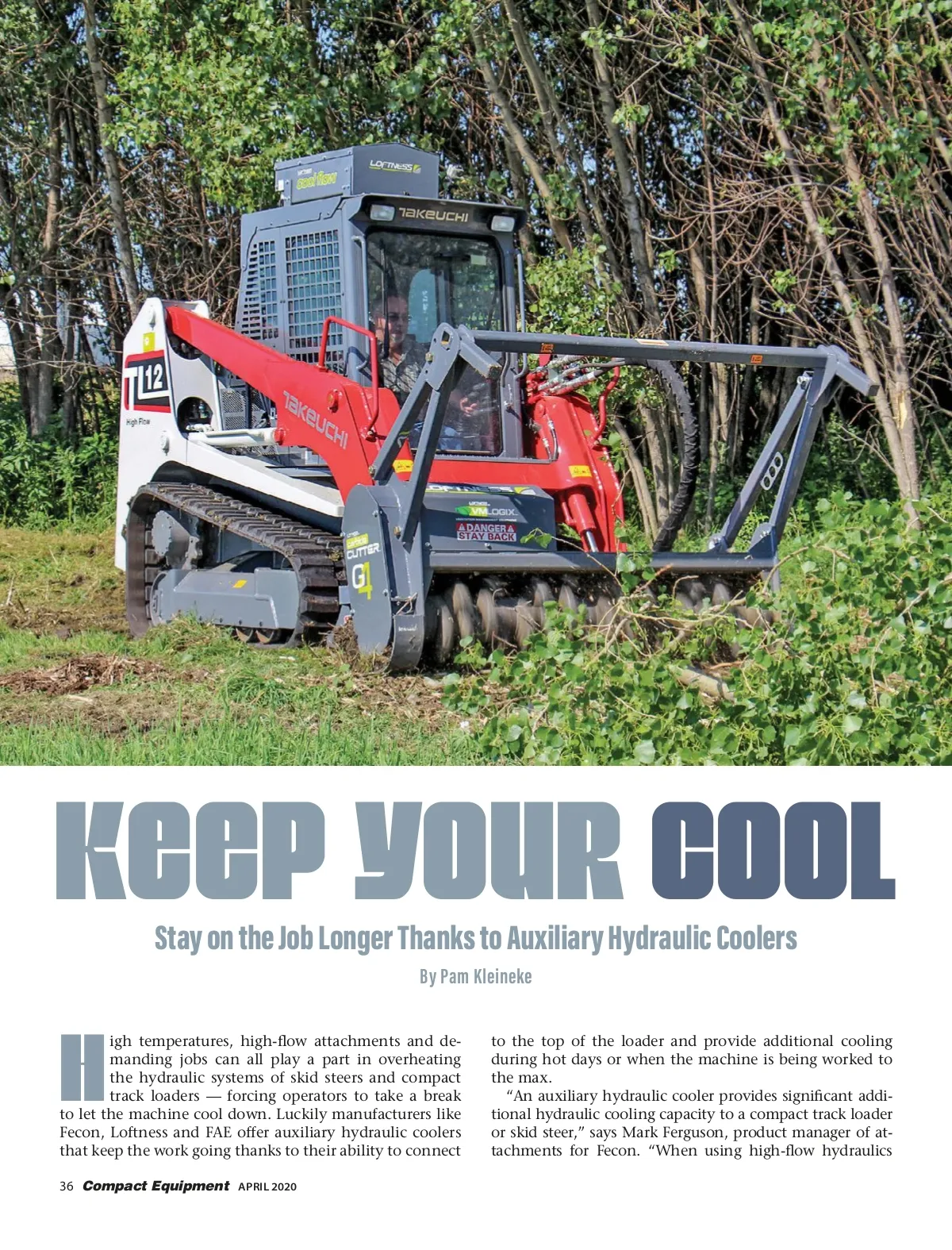
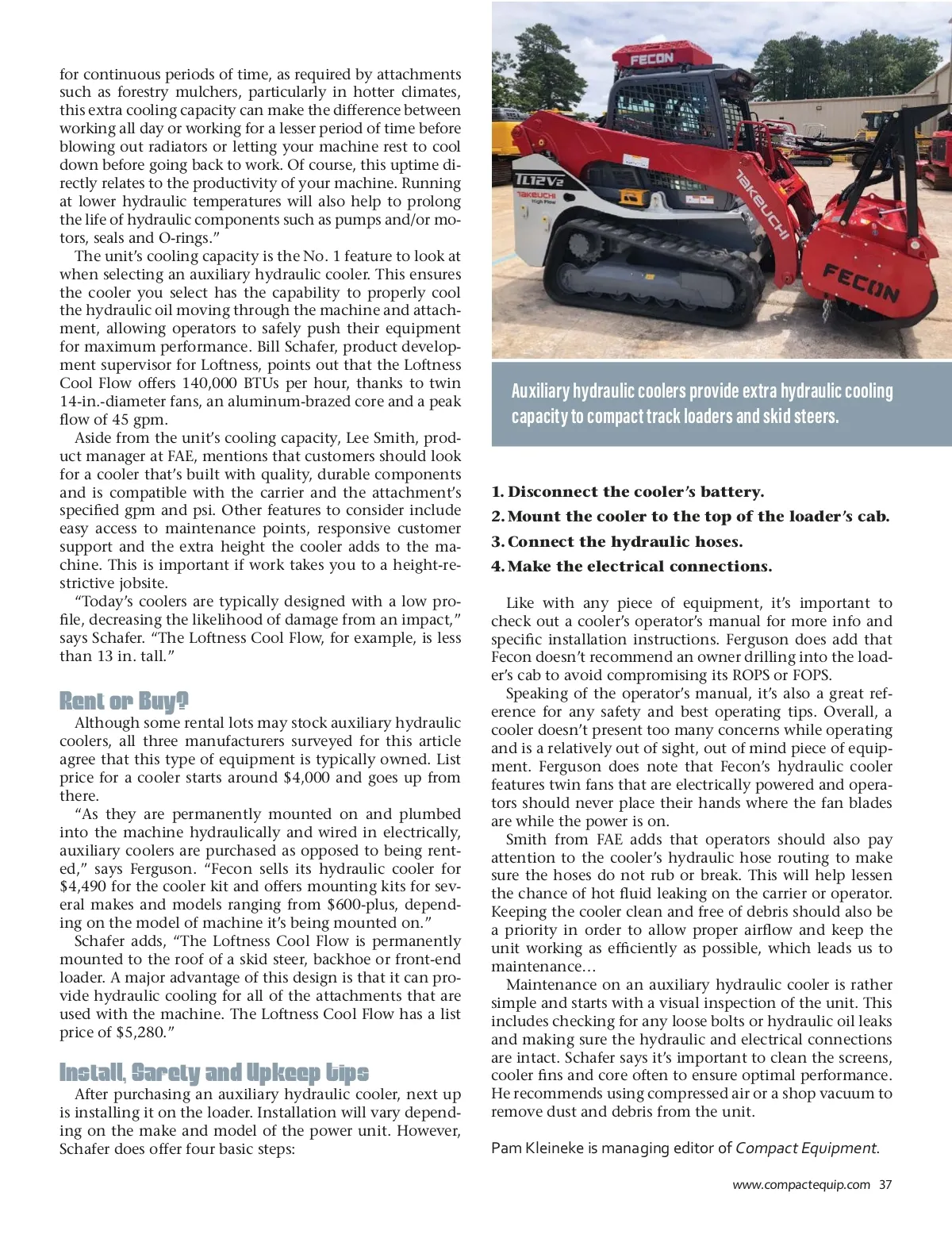
for continuous periods of time, as required by attachments such as forestry mulchers, particularly in hotter climates, this extra cooling capacity can make the difference between working all day or working for a lesser period of time before blowing out radiators or letting your machine rest to cool down before going back to work. Of course, this uptime di-rectly relates to the productivity of your machine. Running at lower hydraulic temperatures will also help to prolong the life of hydraulic components such as pumps and/or mo-tors, seals and O-rings.” The unit’s cooling capacity is the No. 1 feature to look at when selecting an auxiliary hydraulic cooler. This ensures the cooler you select has the capability to properly cool the hydraulic oil moving through the machine and attach-ment, allowing operators to safely push their equipment for maximum performance. Bill Schafer, product develop-ment supervisor for Loftness, points out that the Loftness Cool Flow offers 140,000 BTUs per hour, thanks to twin 14-in.-diameter fans, an aluminum-brazed core and a peak flow of 45 gpm. Aside from the unit’s cooling capacity, Lee Smith, prod-uct manager at FAE, mentions that customers should look for a cooler that’s built with quality, durable components and is compatible with the carrier and the attachment’s specified gpm and psi. Other features to consider include easy access to maintenance points, responsive customer support and the extra height the cooler adds to the ma-chine. This is important if work takes you to a height-re-strictive jobsite. “Today’s coolers are typically designed with a low pro-file, decreasing the likelihood of damage from an impact,” says Schafer. “The Loftness Cool Flow, for example, is less than 13 in. tall.” Auxiliary hydraulic coolers provide extra hydraulic cooling capacity to compact track loaders and skid steers. 1. Disconnect the cooler’s battery. 2. Mount the cooler to the top of the loader’s cab. 3. Connect the hydraulic hoses. 4. Make the electrical connections. Like with any piece of equipment, it’s important to check out a cooler’s operator’s manual for more info and specific installation instructions. Ferguson does add that Fecon doesn’t recommend an owner drilling into the load-er’s cab to avoid compromising its ROPS or FOPS. Speaking of the operator’s manual, it’s also a great ref-erence for any safety and best operating tips. Overall, a cooler doesn’t present too many concerns while operating and is a relatively out of sight, out of mind piece of equip-ment. Ferguson does note that Fecon’s hydraulic cooler features twin fans that are electrically powered and opera-tors should never place their hands where the fan blades are while the power is on. Smith from FAE adds that operators should also pay attention to the cooler’s hydraulic hose routing to make sure the hoses do not rub or break. This will help lessen the chance of hot fluid leaking on the carrier or operator. Keeping the cooler clean and free of debris should also be a priority in order to allow proper airflow and keep the unit working as efficiently as possible, which leads us to maintenance… Maintenance on an auxiliary hydraulic cooler is rather simple and starts with a visual inspection of the unit. This includes checking for any loose bolts or hydraulic oil leaks and making sure the hydraulic and electrical connections are intact. Schafer says it’s important to clean the screens, cooler fins and core often to ensure optimal performance. He recommends using compressed air or a shop vacuum to remove dust and debris from the unit. Although some rental lots may stock auxiliary hydraulic coolers, all three manufacturers surveyed for this article agree that this type of equipment is typically owned. List price for a cooler starts around $4,000 and goes up from there. “As they are permanently mounted on and plumbed into the machine hydraulically and wired in electrically, auxiliary coolers are purchased as opposed to being rent-ed,” says Ferguson. “Fecon sells its hydraulic cooler for $4,490 for the cooler kit and offers mounting kits for sev-eral makes and models ranging from $600-plus, depend-ing on the model of machine it’s being mounted on.” Schafer adds, “The Loftness Cool Flow is permanently mounted to the roof of a skid steer, backhoe or front-end loader. A major advantage of this design is that it can pro-vide hydraulic cooling for all of the attachments that are used with the machine. The Loftness Cool Flow has a list price of $5,280.” Rent or Buy? Install, Safety and Upkeep Tips After purchasing an auxiliary hydraulic cooler, next up is installing it on the loader. Installation will vary depend-ing on the make and model of the power unit. However, Schafer does offer four basic steps: Pam Kleineke is managing editor of Compact Equipment. www.compactequip.com 37
Compact Equipment April 2020: Page 37