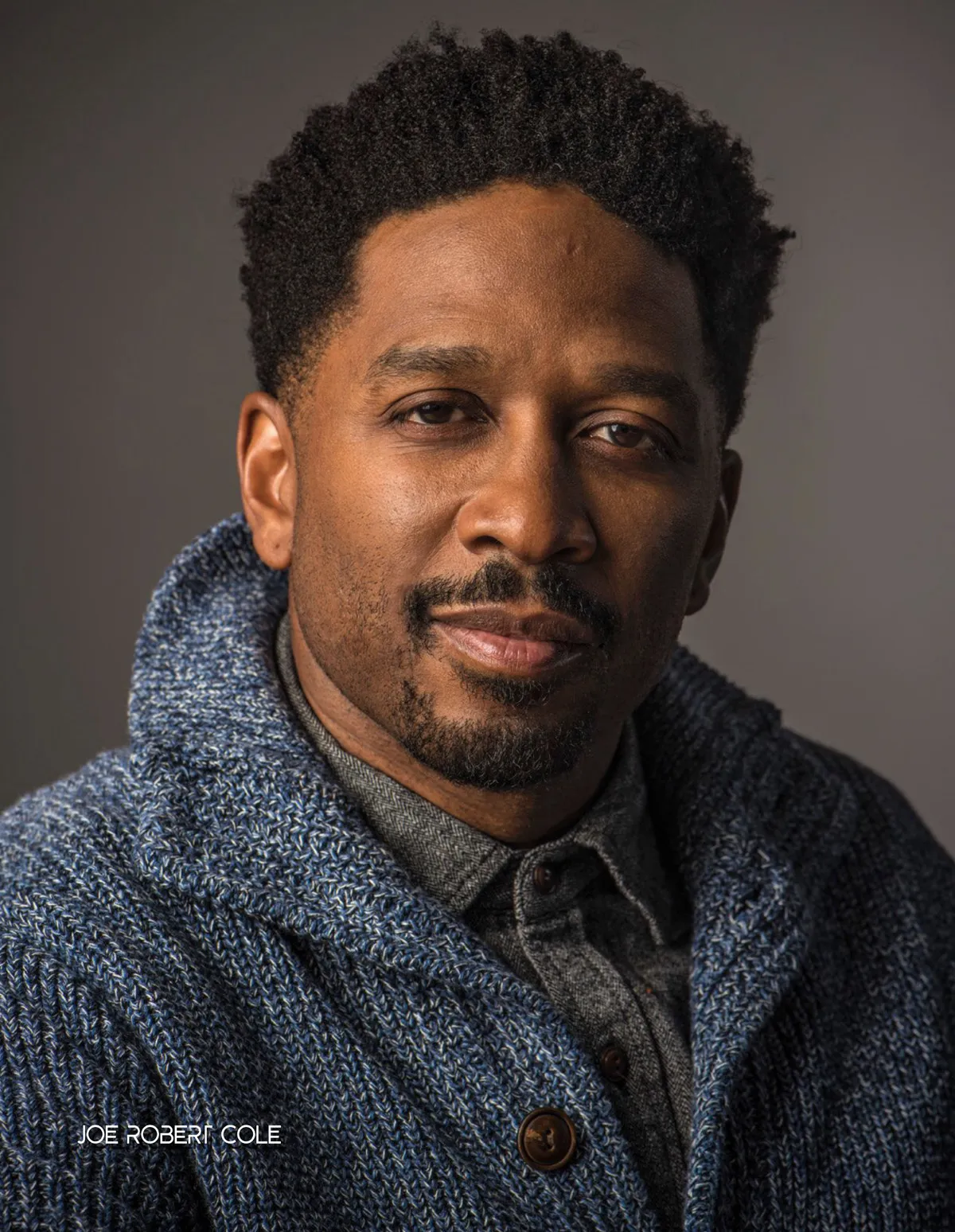
“In African-American culture, because of the political and social realities we’ve been up against, we find ourselves oftentimes in matriarchal situations, where women have had to take the lead, and it’s a common through line. And then in my travels back to the continent to do research, I found that women traditionally hold a lot of power in a lot of African cultures, so that was something we were really trying to highlight— how they carry themselves, how they talk to the men.” —Ryan Coogler where the god they worship is a female god, the goddess Bast? Their elite force of warriors is all women. With Shuri, Nakia, Ramonda, and Okoye, we thought about all those things— how they carry themselves, how they talk to the men… Cole: And how the men talk to them… Coogler: We were very conscious about trying to show a kind of equality that feels real and grounded in the research we’ve done, but also feels different from what we’re used to seeing in a lot of films. POLITICS OF ENGAGEMENT But that’s something that, you know, hopefully the story can continue and Agent Ross’ role in the story will be something that continues to get explored. You have Killmonger killing his girlfriend in cold blood, and then choking a Black elder woman. There’s a way in which the film seems to align Black liberation poli-tics with sociopathy. That kept a lot of Black viewers from embracing the film, or fully embracing it. Cole: I think we all come to a film or a book or whatever with experiences we’ve had and the perspective we have, so I’m certainly not one to say that what someone got out of a film is not real, legitimate, or valid. I would start by say-ing that. That certainly wasn’t our intention, to delegitimize anything. How we viewed Killmonger is that he’s someone who has been damaged and hurt, and has adopted some of the tactics of those who have colonized. He employs the kind of torture and abuse that is used for control. And his pain—the pain he has experienced and the thing he has been fighting against for so much of his life—he has be-come that, in a way. He has adopted the tactics that have scarred him. That is his flaw—that he has adopted the kind of terrorist tactics that historically Africans and African-Americans have suffered under. I think it was much more about him as an individual than him being representative of a movement. We’re in the midst of a Black cultural renaissance even as the world seems to be imploding. Extraordinary lit-erature, films, and visual art are being created by Black artists across the country, and around the world. Have you thought at all about the correlation between the vola-tile moment in which we now live, and the robust state of Black creativity? Cole: It’s a beautiful time in terms of opportunity for people who’ve historically been disenfranchised. I think the way I would answer that question is that in times of transi-tion, it can be tumultuous. My hope is that all of this is a progression toward something better, a step in our contin-ued evolution as people. There are folks who don’t want that progression to occur, and that’s been the case throughout history probably. I think that’s perhaps the moment we’re in right now. FEBRUARY | | MARCH MARCH 2018 2019 FEBRUARY WGA W WRITTEN WRITTEN BY BY WGA W Given the role of the CIA in decimating the ranks of Black activists in America and around the world, a lot of viewers were put off with CIA Agent Ross [Martin Free-man] being framed as a hero in the film. Were you sur-prised at the intensity of that reaction? Have you talked about it since the film’s release? Coogler: We haven’t talked about the response to it or anything, but we would talk about it while we were making it. I’ve never been one to try to correct people on how they feel about my work. How people take the film is how they take it. I never want someone to watch one of my films and say, ‘I got a problem with this part and this part,’ only for me to tell them, ‘No, you’re wrong.’ I think it’s not my place to say that. But the Agent Ross character was always there in the books and we had to find a way to have him in the film in a way that made sense. It made sense to us for him to work for that part of the United States government. The relationship he has with T’Challa in the books grows and evolves. He ends up hav-ing to question whether he’s gonna be loyal to the Unit-ed States or if he’s going to be loyal to T’Challa, who he’s formed a friendship with. For us, Ross isn’t necessarily a hero in the film. In the third act, he’s operating under the direction of Shuri, who kinda tells him exactly what to do and is coaching him on what to do. He’s operating under her instructions. But there’s not a lack of awareness on our part of what that character is and what he represents. We’re obviously aware of what that means, and it’s not something that’s not voiced in the film. Okoye is saying, ‘Yo, this dude…’ She points out what the issue is and T’Challa makes a decision to trust this cat based on his personal relationship with him. 41 • • 39
Written By February March 2019: Page 41